Table of Contents
Customer Lifetime Value (CLV), also called lifetime customer value, estimates the total revenue or profit a business can expect from a customer throughout the relationship. It helps businesses understand how valuable their customers are over time rather than focusing only on individual purchases.
For example, a customer who spends $50 once may be less valuable than a subscriber who pays $20 monthly for three years. Understanding this difference helps businesses make better decisions about marketing, pricing, customer service, and retention.
CLV is especially useful for subscription businesses, e-commerce stores, service providers, and companies that depend on repeat purchases or recurring revenue.
Why CLV Matters for Businesses
Calculating CLV helps businesses:
- Measure customer profitability over time.
- Evaluate customer acquisition and retention strategies.
- Estimate future revenue and support revenue forecasting.
- Identify valuable customer segments.
- Set appropriate marketing budgets.
- Improve customer loyalty and long-term relationships.
When businesses understand customer value, they can allocate resources more effectively and focus on sustainable growth.
How to Calculate Customer Lifetime Value
There are several ways to calculate CLV, depending on the available data and the business model. A simple revenue-based formula works well for an initial estimate, while a profit-based calculation provides a more useful view of financial performance.
The Basic CLV Formula
A common simplified formula is:
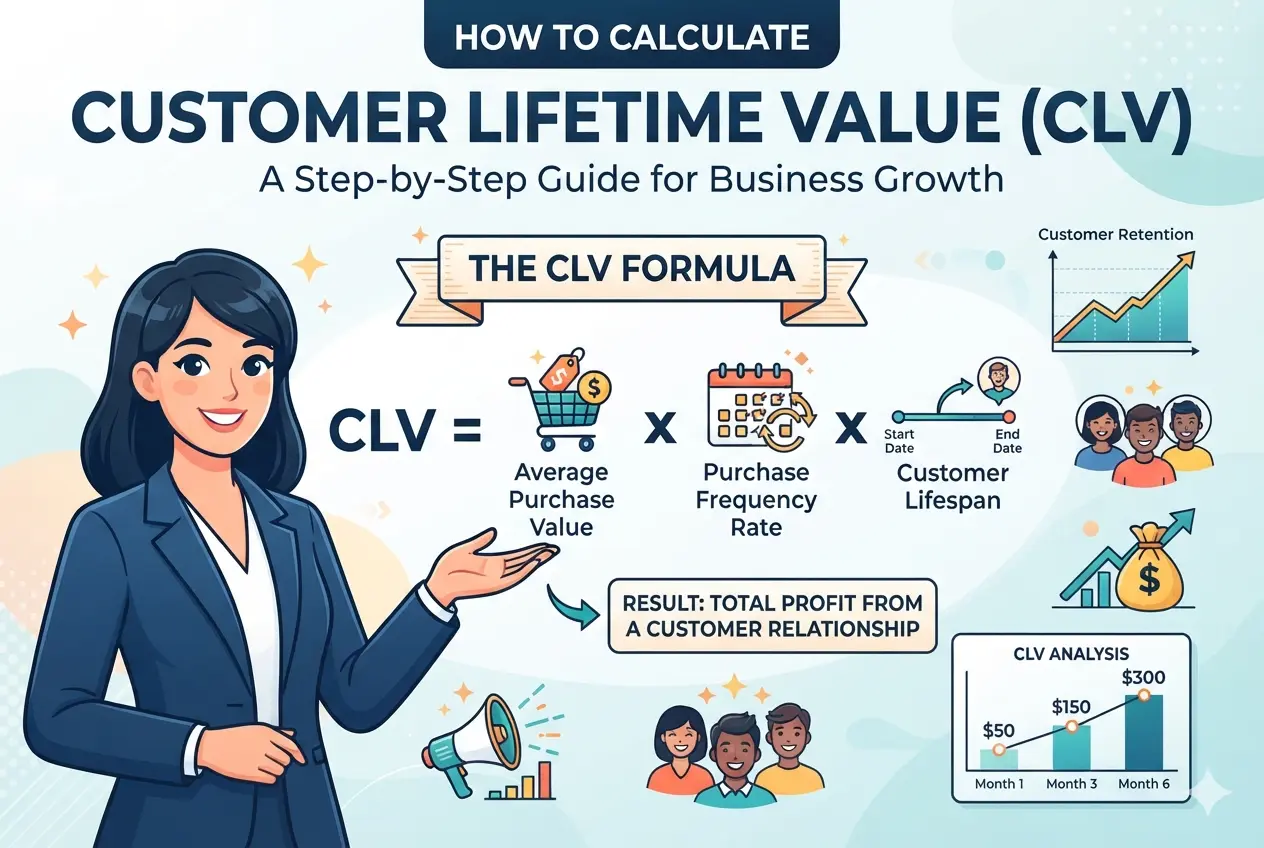
Customer Lifetime Value = Average Purchase Value × Purchase Frequency × Average Customer Lifespan
Where:
- Average Purchase Value: The average amount a customer spends per transaction.
- Purchase Frequency: The average number of purchases a customer makes within a specific period.
- Average Customer Lifespan: The average duration a customer continues buying from the business.
All three values must use consistent time periods. For example, if purchase frequency is measured annually, customer lifespan should also be measured in years.
For a profit-based estimate, include the gross profit margin:
Profit-Based CLV = Average Purchase Value × Purchase Frequency × Customer Lifespan × Gross Profit Margin
This version estimates the gross profit generated by a customer before acquisition costs and other expenses not included in the margin.
A Step-by-Step CLV Calculation
Follow these steps to estimate customer lifetime value.
Step 1: Calculate average purchase value
Divide total sales revenue by the number of purchases during a chosen period.
Average Purchase Value = Total Revenue ÷ Number of Purchases
Step 2: Calculate purchase frequency
Divide the number of purchases by the number of unique customers during the same period.
Purchase Frequency = Total Purchases ÷ Number of Unique Customers
Step 3: Estimate customer lifespan
Use historical customer data to estimate how long customers typically remain active. Subscription businesses can analyze cancellations, while retail businesses can examine the period between first and last purchases.
Step 4: Calculate CLV
Multiply average purchase value by purchase frequency and customer lifespan.
Step 5: Adjust for profitability
If you want to understand customer profitability rather than revenue alone, multiply the result by the gross profit margin. Consider acquisition costs separately when assessing the overall economics of acquiring customers.
Example of Customer Lifetime Value Calculation
Suppose an online store has the following customer data:
| Metric | Value |
|---|---|
| Average purchase value | $80 |
| Purchases per year | 4 |
| Average customer lifespan | 3 years |
| Gross profit margin | 40% |
First, calculate lifetime customer revenue:
CLV = $80 × 4 × 3 = $960
The estimated customer generates $960 in revenue over three years.
Next, calculate profit-based CLV:
Profit-Based CLV = $960 × 40% = $384
The customer is expected to generate $384 in gross profit over the relationship, before customer acquisition costs and other expenses not included in the gross margin.
This distinction matters because a customer who generates substantial revenue may still have low profitability if product costs, discounts, returns, or service expenses are high.
CLV vs. Customer Acquisition Cost (CAC)
Customer Acquisition Cost (CAC) measures how much a business spends to acquire a new customer. CLV estimates the value that customer generates over time.
For example, if a business spends $120 to acquire a customer and expects $480 in profit-based lifetime value, its CLV-to-CAC ratio is:
CLV-to-CAC Ratio = $480 ÷ $120 = 4:1
This means the estimated lifetime value is four times the acquisition cost.
A higher ratio can indicate healthier customer economics, but there is no universal target for every business. Companies should also consider cash flow, operating expenses, the time needed to recover acquisition costs, and the reliability of their CLV estimates.
For a meaningful comparison, use profit-based CLV rather than revenue-based CLV whenever possible. Comparing revenue directly with acquisition cost can make a business appear more profitable than it really is.
Factors That Influence Customer Lifetime Value
Several factors can increase or decrease CLV.
Customer retention: Customers who remain active longer generally generate more lifetime revenue. Better support, reliable products, and effective onboarding can improve retention.
Purchase frequency: Customers who buy more often may generate greater value without requiring an entirely new acquisition campaign.
Average customer value: Increasing the average order value through relevant bundles, upgrades, or complementary products can improve CLV.
Gross profit margin: Higher margins increase the profit generated from each purchase, assuming other factors remain constant.
Customer loyalty: Positive experiences, consistent quality, and relevant rewards can encourage repeat purchases and long-term relationships.
Recurring revenue: Subscriptions and ongoing service contracts can make revenue more predictable, although cancellations and payment failures still need to be considered.
Customer service costs: Customers who require extensive support, refunds, or returns may generate less profit than their revenue suggests.
How to Increase Customer Lifetime Value
Businesses can improve CLV by strengthening customer relationships and increasing the value of each relationship.
- Improve customer retention: Resolve problems quickly, provide reliable service, and communicate with customers after purchase.
- Personalize customer experiences: Use customer relationship management (CRM) tools to deliver relevant offers and messages.
- Encourage repeat purchases: Introduce loyalty programs, replenishment reminders, subscriptions, or useful follow-up recommendations.
- Increase average order value: Offer relevant bundles, product upgrades, or complementary products without pressuring customers.
- Reduce unnecessary churn: Identify why customers stop buying or cancel subscriptions and address recurring issues.
- Improve profitability: Review product costs, discounts, returns, and service expenses to protect margins.
- Measure performance by customer segment: Compare CLV across acquisition channels, product categories, and customer groups to identify the most sustainable opportunities.
Track these changes over time rather than assuming that every campaign will immediately improve lifetime value.
Common Mistakes When Calculating CLV
CLV is an estimate, and incorrect assumptions can make it misleading.
Common mistakes include:
- Using total revenue without considering profit margins.
- Mixing monthly purchase frequency with a lifespan measured in years.
- Estimating customer lifespan from a short or unrepresentative period.
- Ignoring refunds, discounts, cancellations, and inactive customers.
- Treating every customer segment as equally valuable.
- Comparing CLV and CAC calculated over inconsistent periods or using different cost definitions.
- Assuming historical customer behavior will remain unchanged indefinitely.
For more reliable revenue forecasting, update calculations regularly and compare predicted customer value with actual results. Businesses with sufficient data can also calculate CLV by customer cohort, acquisition channel, or subscription plan.
How a Customer Lifetime Value Calculator Helps
A Customer Lifetime Value Calculator simplifies the calculation by allowing you to enter average purchase value, purchase frequency, customer lifespan, and gross profit margin.
The calculator can estimate lifetime customer revenue, profit-based CLV, and the potential value of improving customer retention or purchase frequency. When combined with a Customer Acquisition Cost Calculator, it can help evaluate acquisition efficiency and long-term customer profitability.
For example, you can compare different scenarios to see how increasing the average customer lifespan from two years to three years affects lifetime value. These estimates support planning, but they should be treated as forecasts rather than guaranteed results.
Frequently Asked Questions
What is a good Customer Lifetime Value?
There is no universal good CLV. It depends on the industry, pricing, margins, customer behavior, and acquisition costs. Compare CLV with CAC and assess whether customers generate enough profit to support other business expenses.
Is CLV the same as customer lifetime revenue?
No. Customer lifetime revenue measures the total revenue generated by a customer. CLV is sometimes used to mean revenue-based value, but profit-based CLV accounts for margins and provides a clearer view of the economic value of a customer relationship.
How often should a business calculate CLV?
Review CLV monthly or quarterly when customer behavior changes frequently. Subscription businesses may monitor it more often, while businesses with longer purchase cycles may benefit from reviewing it less frequently.
Can small businesses calculate CLV?
Yes. Small businesses can start with average purchase value, purchase frequency, and estimated customer lifespan. As more sales and retention data become available, they can refine the calculation using customer segments and profit margins.