
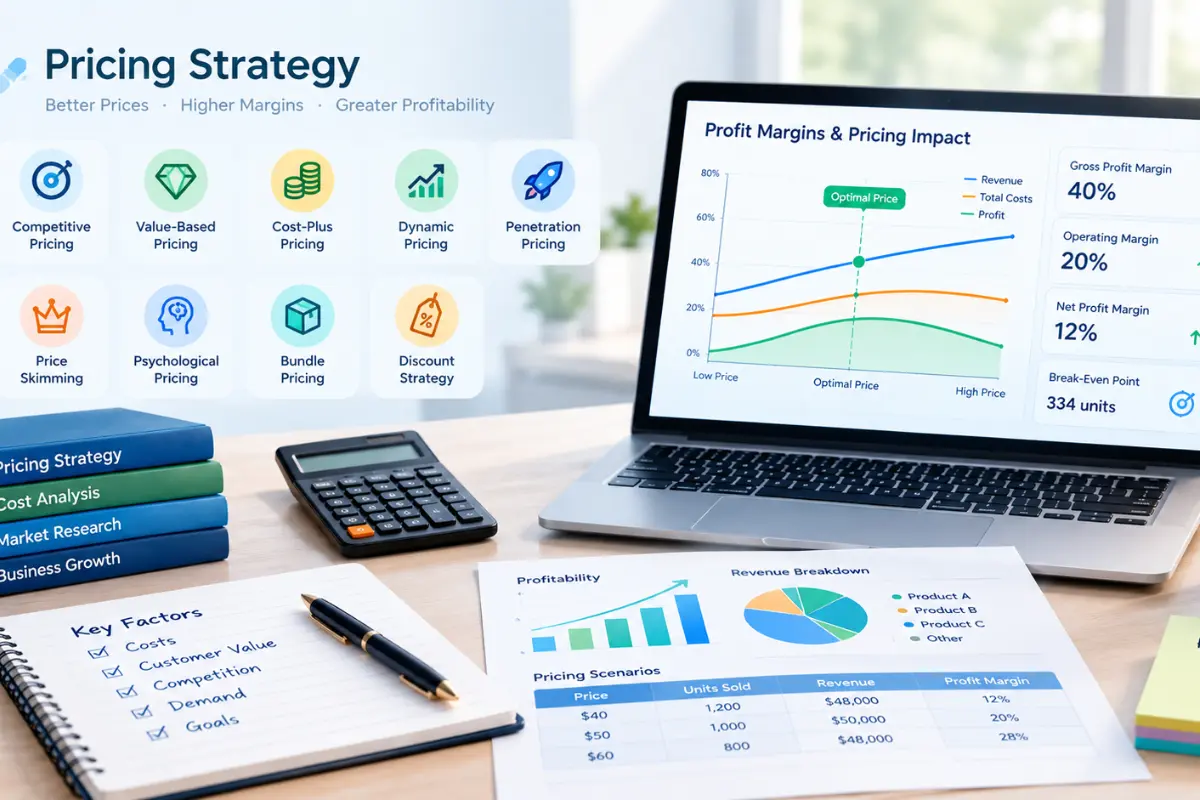
Table of Contents
How Pricing Affects Profitability
Pricing is one of the most important decisions a business makes. It directly affects revenue, profit margins, customer demand, market positioning, and long-term business profitability.
A product can sell thousands of units and still generate disappointing profits if its price is too low relative to its costs. On the other hand, a high price may increase the profit earned per sale but reduce demand if customers do not perceive enough value.
This is why an effective pricing strategy is not simply about choosing a number. It requires understanding the relationship between price, costs, customer value, competition, demand, and sales volume.
A well-designed pricing strategy can help a business:
- Increase profit margins
- Recover costs
- Improve revenue
- Position products effectively
- Attract specific customer segments
- Respond to competitors
- Increase average order value
- Support sustainable growth
Understanding how pricing affects profitability allows businesses to make pricing decisions based on financial objectives rather than relying entirely on guesswork.
Why Pricing Has Such a Strong Impact on Profitability
Every sale has a direct relationship between selling price and the amount available to cover costs and generate profit.
Consider a product that sells for $100 and costs $60 to produce and deliver.
The contribution before other expenses is:
$100 − $60 = $40
Now imagine increasing the price to $110 while keeping the cost at $60.
The contribution becomes:
$110 − $60 = $50
That is a $10 increase per sale.
However, the business must also consider whether customers will continue purchasing at the higher price.
This creates the central pricing challenge:
A higher price can increase profit per unit, but a lower sales volume can offset that benefit.
The right pricing strategy therefore balances price and demand.
The Relationship Between Price, Sales Volume, and Profit
Profitability depends on more than price alone.
A simplified formula is:
Profit = (Selling Price − Variable Cost) × Units Sold − Fixed Costs
For example:
- Selling price = $50
- Variable cost = $20
- Units sold = 1,000
- Fixed costs = $15,000
Profit:
($50 − $20) × 1,000 − $15,000
= $30,000 − $15,000
= $15,000
If the price increases to $55 and sales remain at 1,000 units:
($55 − $20) × 1,000 − $15,000
= $35,000 − $15,000
= $20,000
But if the price increase causes sales to fall to 800 units:
($55 − $20) × 800 − $15,000
= $28,000 − $15,000
= $13,000
The example demonstrates why pricing decisions should consider customer demand rather than focusing only on the price increase itself.
Key Factors That Should Influence a Pricing Strategy
Before choosing a pricing model, businesses should evaluate several factors.
Costs
Understand the total cost associated with delivering the product or service.
These can include:
- Manufacturing
- Materials
- Labor
- Shipping
- Packaging
- Payment processing
- Marketing
- Storage
- Software
- Administrative expenses
A price that does not adequately cover relevant costs may create an unsustainable business model.
Customer Value
Customers do not necessarily evaluate a product based only on its production cost.
A product that costs $20 to produce could potentially sell for $100 if customers perceive significant value.
This is one reason value-based pricing can produce very different results from cost-based approaches.
Competition
Competitor prices provide useful market information.
However, matching competitors exactly is not always necessary. A business may charge more if it offers additional value, stronger service, better quality, convenience, or a differentiated customer experience.
Demand
Customer demand can change as prices change.
Understanding price sensitivity helps businesses estimate how a price change might affect sales volume.
Positioning
Price communicates information about a product.
A low price can support an affordability-focused position, while a premium price may support a premium or specialized positioning when supported by appropriate value.
Competitive Pricing
Competitive pricing involves setting prices with reference to competing products or services.
A business may position its price:
- Below competitors
- Around the market average
- Above competitors
Competitive pricing is particularly common in markets where customers can easily compare prices.
However, simply copying competitors can create problems.
If competitors have lower costs, matching their price may reduce your own margins.
A better approach is to understand why competitors charge particular prices and determine whether your product offers a meaningful difference.
Competitive pricing should therefore be treated as market information rather than the only factor determining price.
Value-Based Pricing
Value-based pricing sets prices according to the value customers perceive rather than simply adding a markup to costs.
For example, business software that saves a company hundreds of hours each year may have substantial economic value to the customer.
The software’s price could therefore be based partly on the financial value created.
Value-based pricing works particularly well when:
- The product solves an expensive problem
- Customer outcomes are measurable
- The product is differentiated
- Customers have clear willingness to pay
- Alternatives are less effective
The challenge is accurately understanding customer needs and perceived value.
Cost-Plus Pricing
Cost-plus pricing calculates the product’s cost and adds a desired markup.
For example:
- Product cost = $40
- Markup = 50%
Selling price:
$40 × 1.50 = $60
Cost-plus pricing is simple and can help ensure that costs are considered when setting prices.
However, it does not automatically account for customer willingness to pay or competitor pricing.
A product may cost $40 to produce but customers may only be willing to pay $50. Alternatively, customers may perceive enough value to pay significantly more than $60.
Therefore, cost-plus pricing can be useful as a starting point rather than the only pricing method.
Dynamic Pricing
Dynamic pricing allows prices to change based on market conditions.
Factors may include:
- Demand
- Time
- Inventory
- Seasonality
- Customer behavior
- Availability
- Market conditions
Airlines, hotels, transportation services, and some online retailers commonly use dynamic pricing models.
The potential advantage is that businesses can respond to changes in demand.
However, frequent price changes can create customer dissatisfaction if the pricing appears unpredictable or difficult to understand.
Businesses using dynamic pricing should establish clear rules and monitor both profitability and customer response.
Penetration Pricing
Penetration pricing involves initially setting a relatively low price to attract customers and gain market share.
The approach can be useful when entering a competitive market or launching a new product.
Potential objectives include:
- Building awareness
- Acquiring customers
- Increasing adoption
- Generating initial sales volume
- Establishing market presence
However, low introductory prices can reduce initial margins.
Businesses should have a clear plan for how pricing may evolve as the product becomes established.
Price Skimming
Price skimming takes almost the opposite approach.
A business launches a product at a relatively high price and may gradually lower the price over time.
This approach can be used for:
- Innovative products
- New technologies
- Premium products
- Products with early-adopter demand
The initial higher price can help capture customers willing to pay more.
As the market expands and competition increases, the company may adjust the price to reach additional customer segments.
Psychological Pricing
Psychological pricing considers how customers perceive prices.
Examples include:
- $9.99 instead of $10
- $99 instead of $100
- Premium pricing
- Anchor pricing
- Showing a higher-priced option alongside a standard option
The underlying idea is that the way a price is presented can influence customer perception.
Psychological pricing should complement a sound product and pricing strategy rather than replace it.
If customers do not perceive sufficient value, changing $100 to $99 may have limited impact.
Bundle Pricing
Bundle pricing combines multiple products or services into a single offer.
For example:
- Product A: $50
- Product B: $30
- Product C: $20
Individual total:
$100
Bundle price:
$85
The customer receives a perceived saving, while the business may increase the number of products purchased in a single transaction.
Bundle pricing can increase:
- Average order value
- Product adoption
- Cross-selling
- Customer convenience
However, businesses should calculate the profitability of the complete bundle rather than focusing only on the discount offered.
Discount Strategy
Discounts can generate short-term sales but can also reduce profitability if they are used excessively.
For example, consider a product priced at $100 with a variable cost of $60.
At full price:
$100 − $60 = $40 contribution
With a 20% discount:
Selling price = $80
Contribution:
$80 − $60 = $20
The business has cut its contribution per sale in half.
To generate the same total contribution, it would need significantly more sales.
This is why a discount strategy should be carefully planned.
Businesses can consider using discounts for specific purposes, such as:
- Customer acquisition
- Seasonal promotions
- Inventory clearance
- Volume purchases
- Product launches
- Subscription commitments
- Limited-time offers
How Pricing Affects Profit Margins
Pricing has a direct impact on gross margin.
Suppose:
- Selling price = $100
- Cost = $60
- Gross profit = $40
Gross margin:
$40 ÷ $100 × 100 = 40%
If the price increases to $120 while cost remains $60:
Gross profit = $60
Gross margin:
$60 ÷ $120 × 100 = 50%
This demonstrates how pricing can influence profitability even when the underlying cost remains unchanged.
However, the calculation should also consider potential changes in sales volume.
Pricing and Break-Even Analysis
Pricing is closely connected to the break-even point.
The basic formula is:
Break-Even Units = Fixed Costs ÷ (Selling Price − Variable Cost)
Suppose:
- Fixed costs = $10,000
- Selling price = $50
- Variable cost = $20
Break-even:
$10,000 ÷ ($50 − $20)
= 334 units approximately
If the price increases to $60:
$10,000 ÷ ($60 − $20)
= 250 units
The higher contribution margin reduces the number of units required to cover fixed costs.
This demonstrates why pricing decisions should be evaluated together with sales forecasts and cost structures.
Pricing and Customer Perception
Price can influence how customers perceive a product.
A very low price may create an affordability perception, while a higher price may communicate premium positioning.
However, price alone cannot establish value.
A premium price generally needs to be supported by factors such as:
- Quality
- Features
- Service
- Brand positioning
- Expertise
- Convenience
- Customer experience
- Product performance
If the customer experience does not justify the price, higher pricing can negatively affect demand and retention.
How to Build an Effective Pricing Strategy
A structured pricing process can reduce guesswork.
Step 1: Calculate Your Costs
Understand variable and fixed costs associated with the product or service.
Step 2: Determine Your Desired Margin
Establish the financial objectives for each product or service.
Step 3: Research Competitors
Analyze comparable products, prices, features, positioning, and customer reviews.
Step 4: Understand Customer Value
Identify the problem your product solves and the economic or practical value it creates.
Step 5: Estimate Demand
Consider how different prices could affect sales volume.
Step 6: Test Pricing
Where practical, test different offers or price points and monitor customer behavior.
Step 7: Monitor Profitability
Track revenue, contribution margin, customer acquisition costs, retention, and overall profit.
Pricing should be reviewed periodically because costs, customer expectations, competition, and market conditions can change.
Using a Pricing Strategy Calculator
A Pricing Strategy Calculator can help businesses compare different pricing approaches using a structured set of inputs.
Typical inputs may include:
- Total cost per unit
- Desired profit margin
- Competitor minimum price
- Competitor maximum price
- Customer value perception
- Expected sales volume
- Price elasticity
Potential outputs include:
- Cost-plus price
- Competitive price range
- Suggested price based on the selected assumptions
- Expected sales volume
- Pricing strategy interpretation
The calculator can help businesses explore scenarios before making pricing decisions.
For example, changing the desired margin or competitor price range can show how the resulting price changes.
Common Pricing Mistakes
Pricing Based Only on Costs
Costs matter, but customers ultimately determine whether the market accepts a price.
Copying Competitors
A competitor’s cost structure and business model may be completely different from yours.
Excessive Discounting
Frequent discounts can reduce margins and potentially condition customers to wait for promotions.
Ignoring Customer Value
A business may underprice a product that creates substantial value.
Failing to Review Prices
Costs and market conditions change. A price that worked two years ago may no longer support the same profitability.
Focusing Only on Revenue
Higher sales do not necessarily mean higher profit.
Frequently Asked Questions
What is a pricing strategy?
A pricing strategy is a structured approach for determining how much to charge for products or services based on costs, customer value, competition, demand, and business objectives.
Which pricing strategy should a business use?
The appropriate approach depends on the business model, customers, market conditions, costs, competition, and objectives. Businesses may also combine different approaches across products or customer segments.
Does increasing price always increase profit?
No. A higher price increases revenue per sale but may reduce demand. The overall effect depends on how sales volume changes.
What is the difference between cost-plus and value-based pricing?
Cost-plus pricing starts with the product’s cost and adds a markup. Value-based pricing considers the value customers perceive and the outcomes the product provides.
Why are discounts potentially dangerous for profitability?
Discounts reduce the amount earned per sale. If the additional sales volume does not compensate for the lower contribution per unit, total profit can decrease.
How often should a business review its pricing?
There is no universal schedule. Businesses can review pricing when costs, competitors, customer demand, product features, market conditions, or strategic objectives change.