
Customer acquisition is essential for business growth, but attracting new customers comes at a cost. Businesses invest in advertising, sales teams, content marketing, software, and other activities to turn prospects into paying customers. Understanding how much these activities cost is crucial for building a profitable business.
Customer Acquisition Cost (CAC) is a key performance metric that measures the average amount a business spends to acquire one new customer. By calculating CAC, businesses can evaluate marketing efficiency, improve customer conversion, and make better decisions about their growth strategy.
What Is Customer Acquisition Cost (CAC)?
Customer Acquisition Cost represents the average cost of converting a potential customer into a paying customer.
For example, if a company spends $5,000 on marketing and sales during a month and acquires 100 new customers, its CAC is $50 per customer.
This metric helps businesses understand whether their acquisition strategy is financially sustainable. A high CAC may indicate expensive advertising, low conversion rates, or an inefficient sales process. A lower CAC can indicate that the business is acquiring customers more efficiently, provided customer quality and long-term profitability remain strong.
Why CAC Matters for Business Growth
CAC helps businesses:
- Measure marketing and sales efficiency.
- Compare the performance of acquisition channels.
- Set realistic customer acquisition budgets.
- Evaluate profitability and growth potential.
- Identify opportunities to improve conversion rates.
- Compare acquisition costs with customer lifetime value.
Rather than focusing only on website traffic or leads, businesses can use CAC to determine how efficiently they turn marketing investments into paying customers.
Customer Acquisition Cost Formula
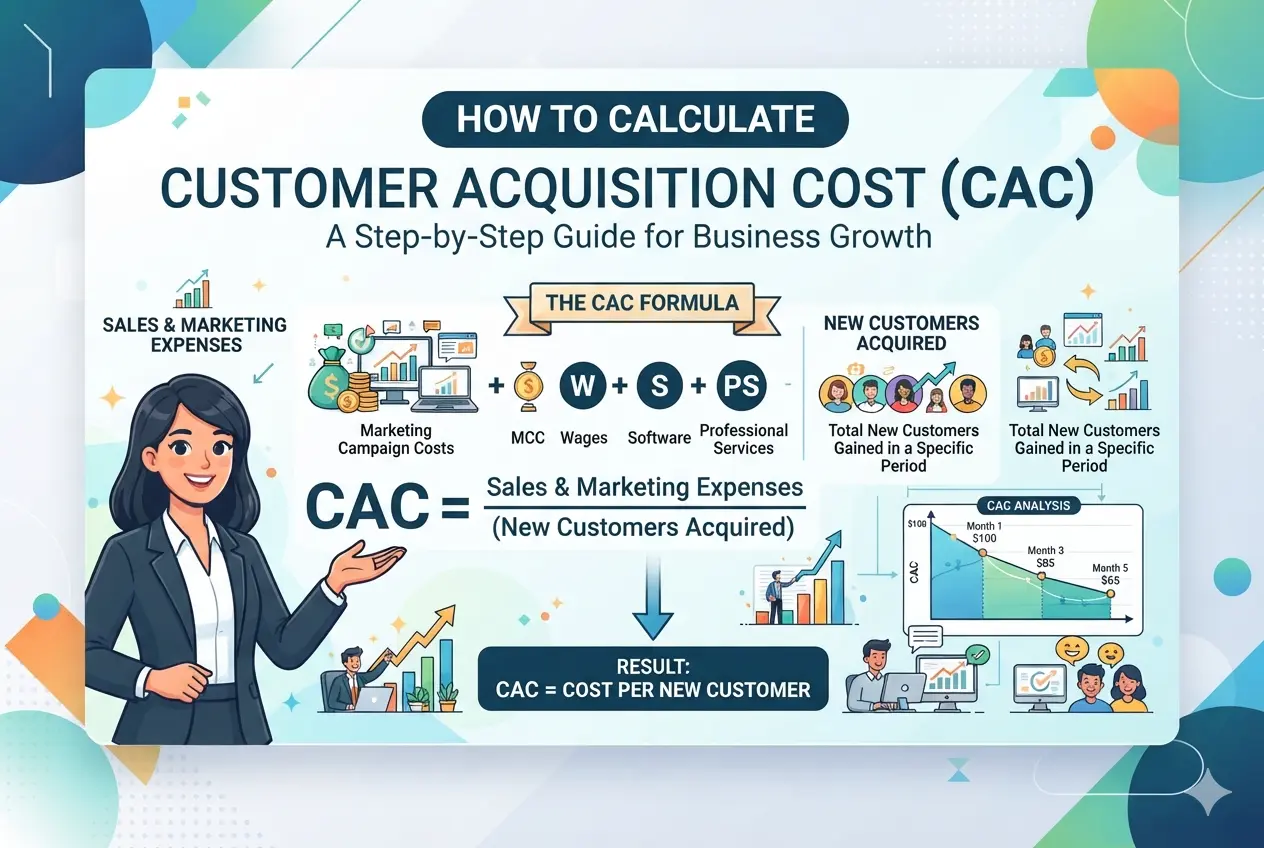
The standard formula is:
CAC = Total Customer Acquisition Costs ÷ Number of New Customers Acquired
Total acquisition costs should include the relevant marketing and sales expenses associated with acquiring customers during the measurement period.
Example of a CAC Calculation
Suppose an online business spends the following amount in one month:
- Advertising: $2,000
- Marketing software: $300
- Sales salaries allocated to acquisition: $1,200
- Content creation: $500
Total acquisition costs are:
$2,000 + $300 + $1,200 + $500 = $4,000
During the same month, the business acquires 80 new customers.
CAC = $4,000 ÷ 80
Customer Acquisition Cost = $50
The business spends an average of $50 to acquire each new customer.
How to Calculate CAC Step by Step
Step 1: Identify Acquisition Expenses
Begin by collecting the expenses associated with acquiring new customers.
These may include paid advertising, marketing agency fees, sales commissions, employee salaries allocated to acquisition, email marketing platforms, CRM software, content production, and lead generation services.
Choose a consistent approach to allocating shared expenses. For example, if a software subscription supports both customer acquisition and customer retention, include only the portion reasonably attributable to acquisition.
Step 2: Calculate New Customers Acquired
Count the number of new paying customers gained during the same period as the expenses.
Use a consistent measurement period, such as a month, quarter, or year. Avoid counting existing customers who renew or make repeat purchases as newly acquired customers unless your reporting method explicitly defines a different acquisition event.
Step 3: Apply the CAC Formula
Divide total acquisition costs by the number of new customers.
For example:
- Total acquisition costs: $12,000
- New customers: 200
CAC = $12,000 ÷ 200 = $60
The company spends an average of $60 to acquire each new customer.
Step 4: Analyze the Results
Compare CAC with previous periods, marketing channels, and customer profitability.
If CAC rises significantly, investigate whether advertising costs increased, conversion rates declined, or the sales process became less efficient.
If CAC decreases, check that the business is still attracting valuable customers who remain active and generate sufficient revenue.
What Costs Should Be Included in CAC?
Marketing and Advertising Costs
Include expenses such as search advertising, social media campaigns, influencer partnerships, promotional content, email marketing, and lead generation.
These costs help attract prospects and move them toward a purchase.
Sales Team Expenses
Sales salaries, commissions, acquisition-related training, and relevant sales tools can contribute to CAC.
This is particularly important for businesses that rely on sales representatives, demonstrations, consultations, or negotiations before converting leads.
Software and Other Acquisition Costs
CRM systems, marketing automation platforms, analytics tools, and agency fees may also be relevant.
For accurate results, include costs consistently and avoid double-counting expenses across marketing and sales reports.
Some businesses calculate paid-media CAC, which includes only advertising expenses, while others calculate fully loaded CAC, which includes broader acquisition-related costs. Clearly label which method you use.
CAC vs Other Marketing Metrics
CAC vs Cost per Lead (CPL)
Cost per Lead measures how much a business spends to generate one lead.
CPL = Lead Generation Costs ÷ Number of Leads Generated
CAC measures the cost of acquiring a paying customer, so it includes the impact of customer conversion.
For example, a campaign may generate leads for $5 each but convert very few of them into customers. Another campaign may have a $15 CPL but produce customers at a lower overall CAC.
Therefore, the lowest CPL does not necessarily represent the most profitable campaign.
CAC vs Customer Lifetime Value (CLV)
Customer Lifetime Value estimates the value a customer generates throughout the relationship with a business.
Comparing CLV with CAC helps determine whether customer acquisition is economically sustainable.
For example:
- CAC: $50
- Estimated customer lifetime value: $200
The CLV-to-CAC ratio is 4:1.
This means the estimated lifetime value is four times the acquisition cost. However, CLV should ideally reflect gross profit or contribution margin rather than revenue alone, and the estimate should account for customer retention and servicing costs.
CAC vs Marketing ROI
Marketing ROI evaluates the financial return generated by marketing relative to its costs. CAC focuses specifically on the average cost of acquiring customers.
Together, these metrics provide a more complete picture of marketing performance.
How to Reduce Customer Acquisition Cost
Improve Conversion Rates
Improve landing pages, simplify checkout, strengthen calls to action, and make product benefits clear.
Even a modest improvement in conversion rate can help the business acquire more customers from the same volume of qualified traffic.
Optimize the Sales Funnel
Analyze every stage of the sales funnel, from initial awareness to purchase.
Identify where prospects abandon the process and address the causes. Better lead qualification, faster follow-up, and relevant product information can improve customer conversion.
Focus on Customer Retention
Although retention does not directly reduce the cost of acquiring a new customer, it can improve overall business economics by increasing the value generated from existing customers.
Loyalty programs, responsive customer support, useful onboarding, and consistent product quality can encourage repeat purchases and longer customer relationships.
Refine Your Customer Acquisition Strategy
Compare acquisition channels based on CAC, customer quality, and long-term profitability.
Invest more in channels that attract suitable customers at sustainable costs, and reconsider campaigns that generate high expenses without delivering sufficient returns.
Common CAC Calculation Mistakes
Avoid these common mistakes:
- Counting leads instead of new paying customers.
- Ignoring sales salaries or relevant software expenses.
- Comparing periods that use different cost definitions.
- Double-counting marketing and sales expenses.
- Treating revenue as profit when evaluating customer value.
- Ignoring the time lag between marketing spend and customer conversion.
- Assuming a lower CAC always means better performance.
- Failing to compare CAC with customer lifetime value.
For businesses with long sales cycles, acquisition costs and resulting customers may not fall within the same reporting period. Cohort analysis or a consistent attribution method can help provide a more accurate picture.
Use a Customer Acquisition Cost Calculator
A Customer Acquisition Cost Calculator simplifies the process of measuring how much your business spends to gain new customers.
By entering total marketing and sales acquisition expenses and the number of new customers acquired, you can calculate your average CAC and compare results across different periods.
For a deeper analysis, combine CAC with cost per lead, conversion rate, customer lifetime value, and marketing ROI. These metrics help reveal which channels are attracting customers efficiently and which need improvement.